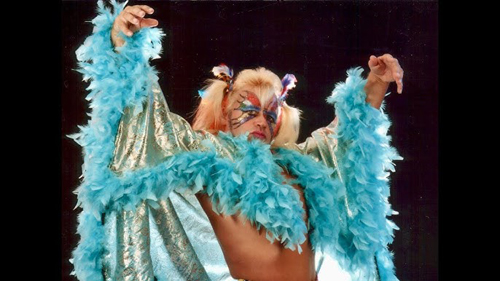
The “sadist in sequins” is no more; “Exotic” Adrian Street has ascended.
Adrian Street was born in Brynmawr, Gwen, Wales in 1940. His father, a former Japanese POW, had spent decades in the coal mines — a destiny a young Adrian wanted no part of. His grandfather, Big Jim Arnold, was what Street called a “mountain fighter”. “They would go into the mountains where they would fight with bare knuckles. He once had a fight that lasted one and half days,” said Street. This road sounded much more exciting than that of a coal miner, and after seeing pro wrestling champions Lou Thesz, “Nature Boy” Buddy Rogers, and his all-time favorite, Don Leo Jonathan, Street began bodybuilding in his early teens. By sixteen, Street had wrestled his first match. It would be the first of an estimated 15,000 that the charismatic wrestler would have over a 57-year career that took him all over the world.
When Street was a kid his father had laughed him when Adrian told him of his dream to be a professional wrestler. His father said he’d be in the mines right next to him — that he was far too small to become a wrestler. Instead of bending to his father’s words, Adrian ran away from home to London and began his training. To make money while he trained, he boxed for a fairground, earning £7 for seven daily fights. Initially dubbed Kid Tarzan Jonathan (a nod to his hero Don Leo Jonathan), Street eventually went back to his given name, developing his “Exotic” character after he noticed how much more riled-up wrestling crowds would get towards him when he acted effeminately.
Smelling money, he changed his entire look to accentuate his character. He bleached his long hair, then tied it up into pigtails. He wore makeup. His wrestling gear was a mix of glitter, sequins, and pastels. As “The Exotic One”, Street would do anything to get a win. This included kissing his opponent when they had him down in a pinning attempt. The uptight masses of the Sixties and Seventies turned Adrian Street into one of the biggest heels in pro wrestling. To combat their ridicule, he would blow kisses to the crowds while skipping around the ring. Their hatred of Street made him a star.
Make a one-time donation
Make a monthly donation
Make a yearly donation
Choose an amount
Or enter a custom amount
Your contribution is appreciated.
Your contribution is appreciated.
Your contribution is appreciated.
DonateDonate monthlyDonate yearlyHis star would shine even brighter after he wrestled English DJ and television personality Jimmy Savile in 1971. In the locker room, Street overheard Savile, then a host on Radio 1 and the host of the popular television show Top of the Pops, “going on about his young conquests”. In front of the promoter, Street, who was set for a world championship rematch against George Kidd at the next event, told Savile, “you’re not a wrestler, you’ll get nothing from me”. When he got Savile into the ring, he destroyed him. Savile painted himself as a tough guy, claiming to be a former bouncer and pro wrestler in his own right, but on that night, Street tied him into knots, dropkicked him onto his head, then yanked out clumps of straw-like hair. “I absolutely crucified the bloke and when I spoke to my wife afterward, she said I’d looked like a hungry fox going after a chicken,” said Street. Jimmy Savile never again stepped into a wrestling ring. Decades later, a criminal investigation would reveal that Savile was one of Britain’s most prolific sexual abusers.
During this same time, Glam Rock was taking over the UK rock ‘n’ roll scene. Eschewing the mod look for something far more garish (and undoubtedly a not-so-subtle pushback from their more conservative, working-class parents), teens were trading in the Beatles LPs of their childhood for something far louder and more outlandish. The Cold War loomed large, the British economy was in shambles — for many youths, personal expression was all they had. In looking at the timeline, one cannot help but ponder how much influence “Exotic” Adrian Street must have had on the popular music subgenre. In the early-’70s, World of Sport, the iconic British wrestling program that featured the likes of Big Daddy, Haystacks Calhoun, and yes, “Exotic” Adrian Street, was watched by millions of Brits every week. T. Rex’s Marc Bolan was in his early twenties when Street hit it big on the program. David Bowie’s Ziggy Stardust alter ego was created a full three years after Street became “exotic”. Mott the Hoople, Slade, The Sweet, Gary Glitter, Roxy Music — every last band changed their style and adopted a “glitter rock” look around this same time. It could easily be argued that “The Exotic One”, who was also known to record a song or two in his day, was a kind of forbearer for the in-your-face style that took over the UK rock world in the early-’70s.
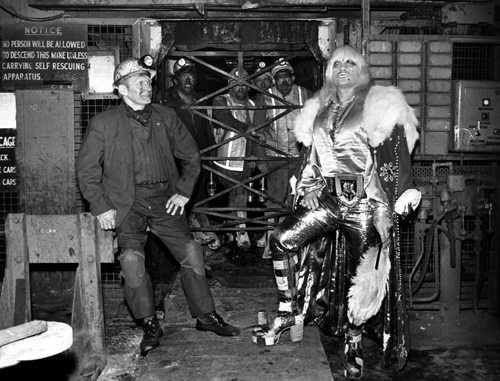
Adrian Street won several territorial championships during his run, but surely none meant more than the European Middleweight title he held in 1973. When the national press took notice of his accomplishment (and act), a photographer was dispatched to cover “The Exotic One”‘s story. Adrian agreed to be photographed, but only if it was in front of the mouth of the very same coal mine in the Beynon’s colliery pithead — with his father — and several of the other miners who once mocked him. The man who was once called “too small” by his father had returned home the conquering champion. The right side of the photo is an image of pride, accomplishment, and a middle finger right between the eyes of his naysayers. If you look at the left side, however, you see fear, confusion, and bitterness. “For whatever reason he (Adrian’s father) didn’t like me — we never got on,” said Street. The photo’s impact on Adrian would only further embolden the wrestler, sending him in search of even more fame and fortune. By the early-’80s, he was stateside, wrestling all over the U.S. before settling down in Birmingham, Alabama, and becoming a regular on Ron Fuller’s Continental Championship Wrestling.
Years earlier, Street had met the woman of his dreams, Linda Gunthorpe Hawker. She wrestled for a time in the UK as Blackfoot Sue before becoming Street’s full-time valet, Miss Linda. Together, they became one of the hottest acts on either side of the pond, packing venues in several countries, including the United States, Mexico, Germany, and the United Kindom. As a side gig, the couple also ran a gym and began designing and selling pro wrestling gear. The gear the legendary Mick Foley wore to the ring when he morphed into his Dude Love character in 1998? That gear was designed by Adrian Street.
Street began to slow things down around 2001 after a cancer diagnosis. He finally got around to proposing to Lina in 2005, at a wrestling show, of course. The best man at his wedding: his boyhood hero Don Leo Jonathan. He still enjoyed his long hikes but retired completely from the ring. Through everything, Linda was always by Adrian’s side. Through cancer, the loss of their gym to Hurricane Ivan, Adrian’s heart issues, the stroke that caused a brain bleed, the subsequent brain surgery, and the sepsis that ultimately claimed his life, Linda was by his side. As he had always done, Adrian fought every step of the way. After he passed, Linda called him “the kindest, most lovely, and loving man”.
“Exotic” Adrian Street was 82.

 Illegal Foreign Object
Leave a comment