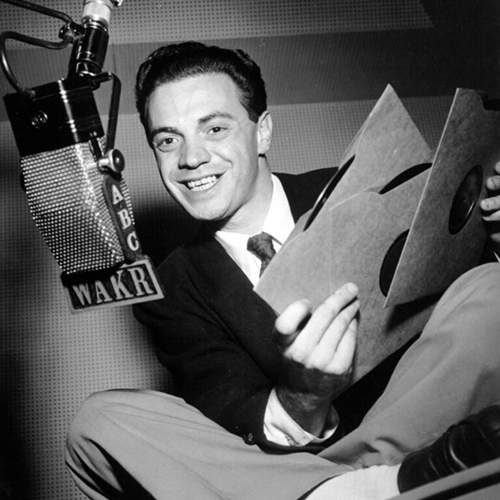
Legendary radio DJ Alan Freed was working for WAKR-AM in Cleveland when he befriended record store owner Leo Mintz. After noticing a trend in his store where white kids were spending more and more time flipping through albums by black artists, Mintz convinced Freed to change his show format from classical music to artists like Fats Domino and Jackie Brenston. It was a gutsy move for the time — most radio hosts weren’t willing to risk the ire of the masses and often chose to play a cover from a white artist rather than an original from a black artist.
Moving over to WJW Radio in 1951 with a Mintz sponsorship in his back pocket, Freed started The Moondog House, a show dedicated to R&B music. One story claims that during one of these broadcasts, Freed supposedly said to Mintz, “Leo, this music is so exciting, we’ve got to call it something,” to which Mintz replied, “Alan, you are rolling tonight. You’re rocking and rolling. Call it rock and roll.”
Another version of the story had Freed renaming R&B to calm white parents’ fear of the music their children were hearing. The glorious irony of reappropriating “rock and roll”, a slang term used by the black community at the time to describe sex, to make R&B music more palatable to middle-aged white people is delicious.
Regardless of its origin, rock and roll exploded into the mainstream. Less than a year later, Mintz would sponsor Freed in another endeavor to push the genre forward. Teaming up with local concert promoter Lew Platt, Freed and Mintz pieced together an event dubbed the Moondog Coronation Ball. On March 21st, 1952, the live show took place at the Cleveland Arena and is considered the first major rock ‘n’ roll concert in history.
Hosted by Freed, the concert was to feature Paul Williams & the Hucklebuckers, Tiny Grimes (who previously played with Art Tatum’s Trio), the Dominoes (they of “Sixty Minute Man” fame), and Varetta Dillard (among others). Unfortunately, counterfeit tickets for the event began circulating before the 21st, resulting in more than 20,000 people trying to shove their way into a venue that held around half that number. After Paul Williams left the stage, Tiny Grimes took to it. His set didn’t last long; due to the sheer number of people, the acoustics in the building became indecipherable. Either the fire marshal or a police captain shut the show down before the planned midnight coronation of the two most popular area teens (hence calling it a coronation ball). Depending on who told the story, the fear was that riots might ensue due to the overcrowding.
Freed went on the radio the following day and apologized for everything. The controversy did nothing but increase his popularity.
It would not be his last time to promote a rock concert. He put on several other live events after taking a job in New York City with WINS in 1954. His “come one, come all” style of concert promotion did nothing to ingratiate himself with local law enforcement hell-bent on preventing what they called “race-mixing”, but their opinions did little to curtail his march forward. If anything, their opposition only emboldened Freed, and it was not uncommon for him to promote a concert that would have Chuck Berry, the Everly Brothers, Jerry Lee Lewis, “Screamin’ Jay” Hawkins, and Buddy Holly, all on the same bill. During a show in Boston, Freed was arrested and charged with attempting to incite a riot after he took to the stage and told the audience, “The police don’t want you to have fun”.
A payola scandal in ’58 would forever tarnish his legacy. Freed took kickbacks from record companies in exchange for airplay on his top-rated radio show. As a bonus, Freed received songwriting credits on certain songs (Chuck Berry’s “Maybellene” being one), meaning he also made royalties on songs he played. Chuck Berry took him to court, eventually winning back full writing credits on the song. In 1960, payola was declared illegal. In 1962, Freed pleaded guilty to two charge of commercial bribery. He was fined and given a suspended sentence, but the controversy ended his career.
Still, Alan Freed’s importance to rock music is undeniable. Countless recording artists became household names due in no small part to his radio promotion. He played a massive role in making rock music a fixture on the Top 40 radio charts while opening doors for black artists to reach a much wider audience.
 Illegal Foreign Object
Leave a comment