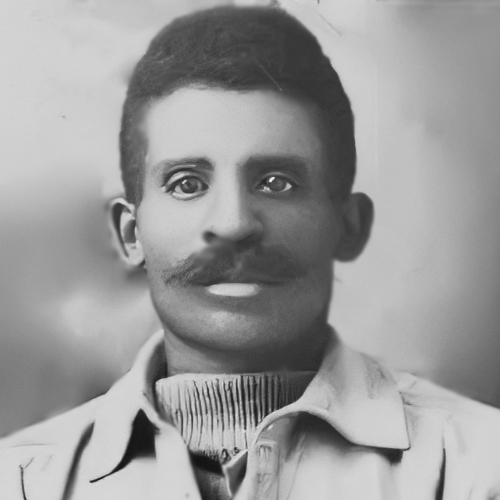
Widely recognized as the first black player to play professional baseball, John W. Jackson Jr., better known to baseball historians as “Bud Fowler”, was born on March 16, 1858. His debut in professional baseball pre-dated Jackie Robinson’s Major League Baseball debut by 60+ years.
Born in Fort Plain, New York, Fowler’s family moved to Cooperstown, New York, a few years later. His father was a barber by trade and taught his son the same skill. Bud would employ his father’s teachings to supplement his income throughout his life, but baseball had his heart.
He made his pro debut in 1878, playing for Chelsea in Massachusetts, Lynn Live Oaks, the Maple Leafs in Ontario, and the Petrolia Imperials between ’78-’79. When his teammates in Guelph, Ontario spoke out against playing with him, he left the team and traveled to the Petrolia Imperials, a team 100 miles southwest of Guelph. The local newspaper stood with Fowler, saying, “We regret that some members of the Maple Leafs are ill-natured enough to object to the colored pitcher Fowler. He is one of the best pitchers on the continent of America, and it would be greatly to the interest of the Maple Leaf team if he were re-instated. He has forgotten more about baseball than the present team ever knew, and he could teach them many points in the game.”
Fowler remained nomadic for the entirety of his career. Stops in Minnesota, Iowa, New York, Vermont, Kansas, Indiana, New Mexico, Texas, California, Nebraska, Michigan, and Colorado followed his time in Ontario, including 34 games for the Binghamton Crickets, with whom he hit .350 while displaying his jackrabbit speed on the bases. Fowler once said he believed he played on baseball teams “based in 22 States and Canada”.
In 1894, Fowler was playing ball in Findlay, Ohio for an unaffiliated minor league team. Frustrated with the constant barrage of racism and the lack of representation in the sport he loved, Fowler convinced the only other black man on his team, shortstop Grant “Home Run” Johnson, to form a barnstorming team. Johnson, a fleet-footed, sweet-swingin’, college-educated man, smelled opportunity. Partnering with a Minnesota businessman named J. Wallace Page, who owned the Page Woven Wire Fence Company, the Page Fence Giants were born.
Fowler acted as a sort of general manager for the team, piecing together a roster of talented players, including catcher Peter Burns, first baseman George Taylor, center fielder Gustavus “Gus” Brooks, and pitchers Billy Holland and Joe “Cannon Ball” Miller. Fowler played second base. His focus when building the team not only centered on acquiring the most talented players — Fowler was also looking for good men. Out of the twelve men on the Giants’ roster, five of them were college graduates.
The team traveled by train in a private railroad car. The car was decorated with the team’s name on the side of the car. When the Giants came to town, a street parade soon followed. It became a hallmark of the team — roll into town, hop on bicycles, and ride through town to the ballpark. It became the primary way the Page Fence Giants players announced their presence (and it wasn’t uncommon for a gaggle of local people to follow them to the park). The street party was just a taste of the theatrics displayed by the team during the games. The Giants were one of the most dominant (and entertaining) barnstorming teams of all time.
Believing his work was done, Fowler left the team mid-way through its first season. The untimely death of 23-year-old “Gus” Brooks, who collapsed on the field during a game and died a few hours later, may have played a role in his departure. Regardless, Bud Fowler’s success with the Page Fence Giants led to the formation of other barnstorming teams, including the Smoky City Giants, All-American Black Tourists, and the Kansas City Stars.
Enjoying the AI-free content? Make a one-time donation and keep the robots from taking over!
Make a monthly donation! I’ll happily buy you a taco when I see you!
Wow, are you gonna make a yearly donation?! This calls for a serious bear hug!
Choose an amount
Or enter a custom amount
Your contribution is appreciated.
Your contribution is appreciated.
Your contribution is appreciated.
DonateDonate monthlyDonate yearlyUnfortunately, the slick-fielding, speedy player with the live arm never found a baseball home. He played everywhere he could get on the field (without a fielding glove), either barnstorming, building, or playing on organized teams until at least 1901. He then got into managing. Fowler packed light and stayed agile in his pursuit of baseball.
Society for American Baseball Research member Brian McKenna wrote: “He was also one of the first significant black promoters, forming the heralded Page Fence Giants and other clubs and leagues. Wherever there was an effort to form a black league during the 19th century, Fowler could be found in the mix … white field managers and business managers through the country sought Fowler’s advice on fellow black players, at times hiring a man sight unseen for their roster on his say-so. Moreover, Fowler was the one who organized the first successful black barnstorming clubs, a subsequent staple of their industry.”
Bud Fowler was loyal to baseball. If only baseball had been half as loyal to him.
On July 24, 2022, baseball finally did the right thing, honoring the life and memory of the man the Cincinnati Enquirer once called the “patriarch of the black sons of swat”. On that day, Fowler “returned” to Cooperstown, and was posthumously inducted into the Baseball Hall of Fame.

 Illegal Foreign Object
Leave a comment