Think about how cool Miles Davis was or how undeniably brilliant Filles De Kilimanjaro, In A Silent Way, and Bitches Brew are.
Now consider that Betty Davis showed him that level of coolness that allowed him to tap into the power necessary to create those masterpieces.
When Betty Davis ascended in February 2022, I remember pondering whether she now inhabits infinity or if infinity inhabits her. She was such a powerhouse — It isn’t out of the question to think she absorbed all of us into her being like a funky Milky Way. What’s 400 billion stars to a bonafide Queen of Funk?
Betty was just 16 when she left home for New York City. It was 1960, and a cultural shift was on the horizon — Paul Simon, Lou Reed, Bob Dylan, and Neil Diamond were also trying to make it in the big city. Davis enrolled in the Fashion Institute of Technology and immersed herself in the burgeoning Greenwich Village scene. Her outgoing nature and stunning looks led to modeling gigs and photo shoots, through which she met all the right people.

One longstanding rumor taps writer and soul singer Lou Courtney as the person who convinced Betty to try recording music, though several historians dispute this. What is certain is that she linked up with a few other women, dubbed themselves the Cosmic Ladies, and DJ’d parties around New York. Through these parties, opportunities to record her music arose. Under her real name Betty Mabry, she recorded two songs, “Get Ready For Betty” and “I’m Gonna Get My Baby Back”, for Don Costa (who discovered Paul Anka and produced albums for Frank Sinatra) and his DCP International record label. Around this same time, she teamed up with Roy Arlington to record the beautiful “I’ll Be There” for Safice Records. While these early musical experiences undoubtedly seasoned her for the business, they would never be sufficient for her needs. Betty Davis aimed far higher than being yet another female artist forced to carry the yoke in a white male-dominated industry. She did not need songwriters, fashion experts, or managers telling her anything about her or her art — she knew all along. Betty Davis had a voice and was intent on using it (and damn anyone who tried to stand in her way or tell her otherwise).
Her connections in the scene led to an opportunity to write music for other artists, including the funky-as-hell Chamber Brothers’ song, “Uptown”. “She wouldn’t shut up about the fact she had a tune that was perfect for us,” said Lester Chambers. The track is raw and loaded with soul — exactly how you’d think a Betty Davis song would sound.
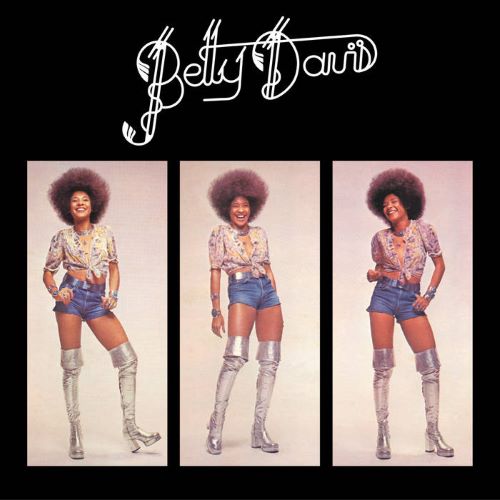
A short-lived relationship with Hugh Masekela and friendships with Jimi Hendrix (whom she met through fellow Cosmic Ladies member and Hendrix lover Devon Wilson) and Sly Stone followed. Then, she married Miles Davis and taught him what cool really looked, sounded, and acted like. Threatened by her energy, the very thing that made him fall for her in the first place, Miles beat Betty multiple times and accused her of having an affair with Hendrix. After a year, Betty left Miles and threw herself into her music. Between 1973 and 1975, she released three of the dirtiest, funkiest, most unabashedly sexy records in history: Betty Davis, They Say I’m Different, and Nasty Gal. She worked with a “Who’s Who” of brilliant artists during this time. On her debut album, Sly and the Family Stone bassist Larry Graham, drummer Gregg Errico, Santana guitarist Neal Schon, the Pointer Sisters, and members of the legendary Tower of Power all contributed to the sessions, which took place at Wally Heider Studios in San Francisco.
Make a one-time donation
Make a monthly donation
Make a yearly donation
Choose an amount
Or enter a custom amount
Your contribution is appreciated.
Your contribution is appreciated.
Your contribution is appreciated.
DonateDonate monthlyDonate yearlyRichard Pryor worshipped her, Muhammad Ali admired her strength, and radio stations banned her. Her live shows were incendiary pieces of performance art — in-your-face, avant-garde funkiness that inspired some of the biggest names in music history. Prince, Madonna, Grace Jones, and Rick James all walked the road that Betty Davis paved to untold riches and success — look no further than Betty’s “If I’m In Luck I Might Get Picked Up”, “Your Man, My Man”, or “Anti Love Song”. Janelle Monáe might not know it, but if you stare deeply enough into her eyes, you’ll see a hint of Betty Davis in her as well. Betty was the blueprint — a walking, talking, raised middle finger — everyone else was playing catchup. She was funk metal fifteen years before it became a music descriptor.
After a trip to Japan in 1980, Betty returned to the U.S. (Homestead, Pennsylvania, more specifically) and decided to step away from her previous life. Over the years, I have read several publications proclaiming her father’s death, mental illness, or record label indifference as possible reasons for her reclusive behavior. That is all speculation — this I know: her solitude became her peace. It was chosen by her, not foisted upon her. It had to be because Betty Davis didn’t half-step anything. Her strength was always in her willingness to push back.
Tracklist:
- If I’m In Luck I Might Get Picked Up 10/10
- Walkin’ Up The Road 10/10
- Anti Love Song 10/10
- Your Man, My Man 9/10
- Ooh Yeah 7/10
- Steppin’ In Her l. Miller Shoes 9/10
- Game Is My Middle Name 8/10
- In The Meantime 8/10
- Come Take Me* 7/10
- You Won’t See Me In The Morning* 8/10
- I Will Take That Ride* 8/10
Grade: 85
*Bonus tracks not included on the original release
 Illegal Foreign Object
Leave a comment